
Just Now, OpenAI Wrote an Official Open-Source Plugin for Claude Code
OpenAI has officially released a Claude Code plugin. Its primary function is to enable one-click invocation of Codex within Claude Code for code reviews, or to directly hand over stuck tasks to Codex for handling. Yes, you read that correctly. OpenAI actively placed its own Codex into Anthropic’s territory.
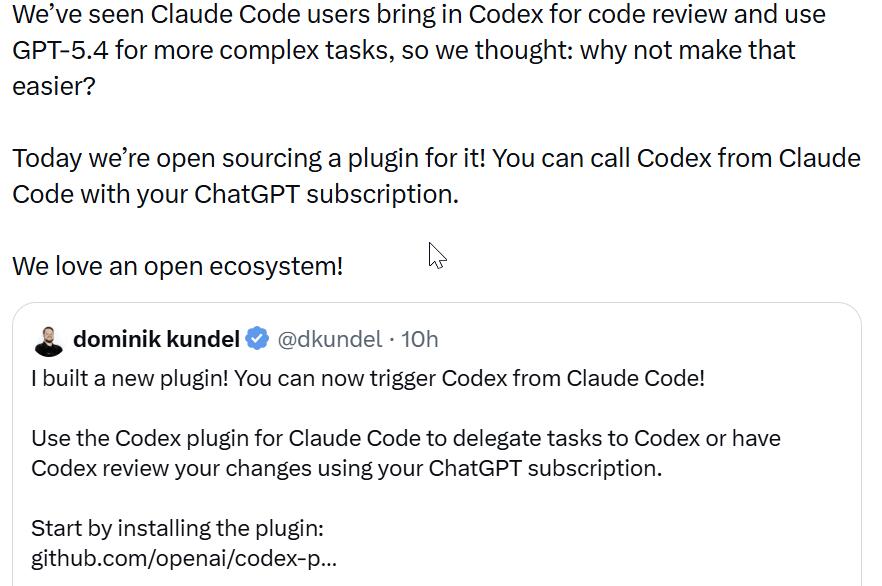
The plugin is named codex-plugin-ccand is completely open-source under the MIT license, with all code, prompts, and agent logic visible. It allows you to call Codex for code reviews with one click within Claude Code, or to transfer tasks that are stuck directly to Codex for takeover.
[Video placeholder: A demo of the plugin in action.]
The interesting part isn’t the functionality, but the stance.
Why Do This?
OpenAI’s Developer Advocate, Romain Huet, explained the motivation on X:
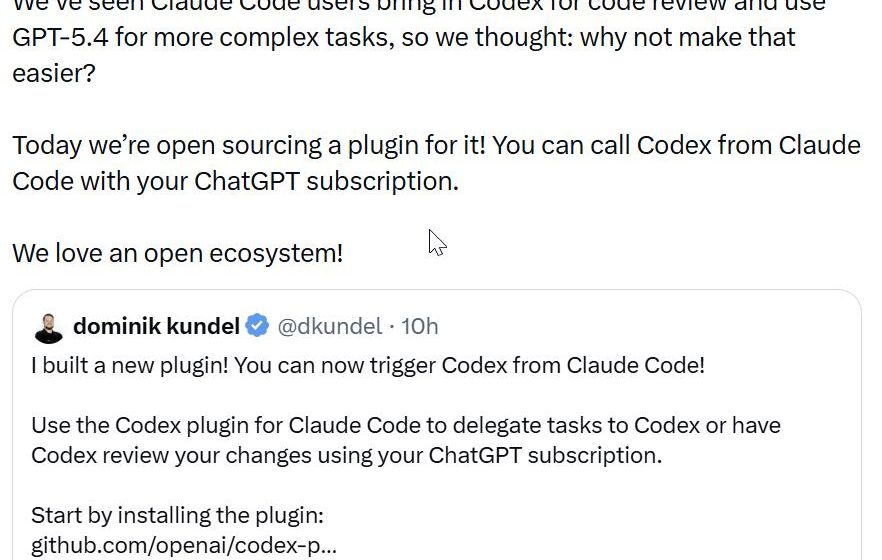
“We’ve seen Claude Code users bring in Codex for code review and use GPT-5.4 for more complex tasks, so we thought: why not make that easier?”
Users were already switching between the two. OpenAI simply decided to build the bridge. “I use Codex to fix Claude Code bugs… I use Claude Code to fix Codex bugs.” Developers no longer care whose tool it is; they use whichever works better. This time, OpenAI chose to go with the flow, packaging Codex as the “on-call second opinion” within the Claude Code workflow.
- Users will mix and match different tools anyway.
- Being the platform that’s willing to play with others can actually infiltrate more workflows.
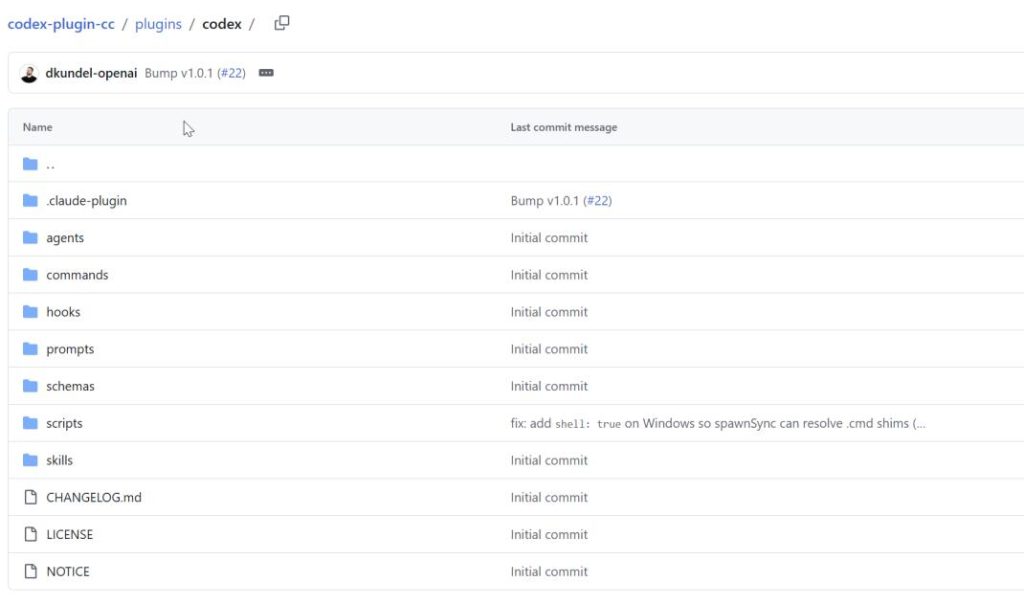
Currently, it has already gained 2.3k Stars.
Three Core Commands
The plugin provides three main commands with different purposes:
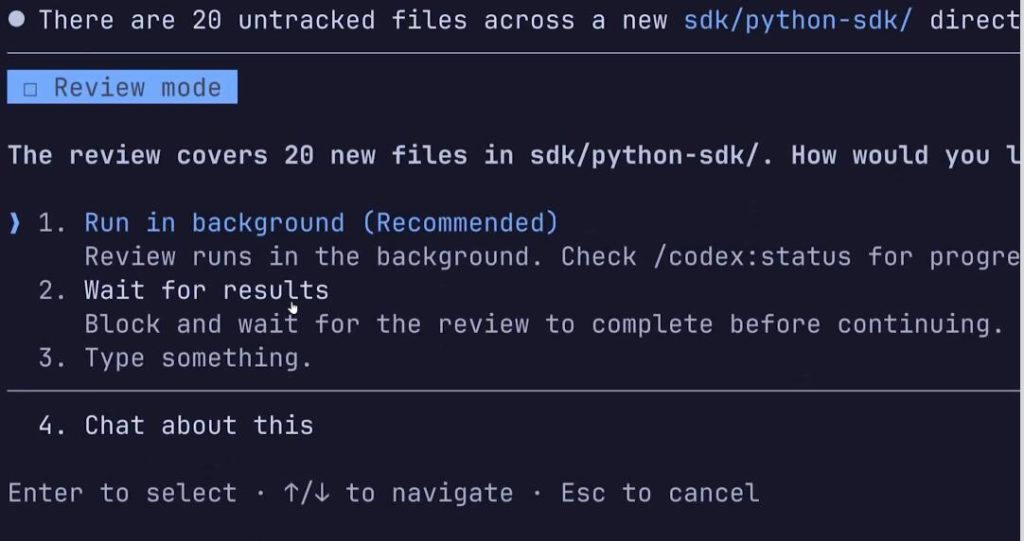
/codex:review is the standard read-only code review. It supports--basefor specifying branch comparison and--backgroundfor running in the background. Suitable for daily PR checks—run it to see if there are obvious issues./codex:adversarial-review is an adversarial review, specifically looking for faults. This feature is quite special—it questions the hidden assumptions of existing implementations. It’s suitable for high-risk operations like migrations, authentication changes, and infrastructure scripts. The official documentation specifically mentions that you can customize the focus areas to make the review more targeted./codex:rescue is for task handover. When a Claude Code thread gets stuck, or you want to start over with a different approach, you can hand the entire task over to Codex. It supports--resumeto continue from the previous progress.
All three commands support background execution. Use /codex:statusto check progress and /codex:resultto retrieve results.
A Potential Pitfall to Note
The plugin has an optional Review Gate feature that can prevent Claude Code from exiting before the Codex review is complete. It sounds convenient, but OpenAI’s Srivastav specifically warned: This could lead to the two Agents calling each other in a loop, quickly burning through usage credits. Consider this before using it.
How Is It Implemented Technically?
The plugin itself is lightweight, not an independent runtime. It acts as a relay through the local Codex CLI and App Server, reusing your existing authentication and configuration. If you previously configured ~/.codex/config.tomlor a project-level .codex/config.toml, the plugin will inherit it directly—no need to reconfigure.
Prerequisites: A ChatGPT account (free version works) or an OpenAI API key, plus Node.js 18.18 or higher.
Installation (3 Steps)
bashbash/plugin marketplace add openai/codex-plugin-cc
/plugin install codex@openai-codex
/codex:setup
/codex:setupchecks if Codex is installed, if authentication is normal, and will prompt you on how to fix any issues.
Known Issues:
- Node.js versions below 18.18 will cause errors.
- Multi-file reviews can take a long time; it’s recommended to add
--background.
Final Thoughts
“I find Gemini better for pretty frontends, Claude Opus for planning. Gemini and Opus for code reviews. Codex is great when I want the LLM to follow instructions more strictly.”
Developers have already started assembling AI tools like a band—using whoever is good at what. The community has even seen people build their own bridges, allowing Claude Code and Codex to work collaboratively in a Leader-Worker model.
This plugin from OpenAI essentially paves that road officially. For Claude Code users who occasionally want to switch “brains” for code review, there’s now an official option. Whether OpenAI is doing this out of “openness” or “infiltration” is a topic for the comments section.
Project Address: https://github.com/openai/codex-plugin-cc